




The Critical Role of Certified Chevrolet Tire Service
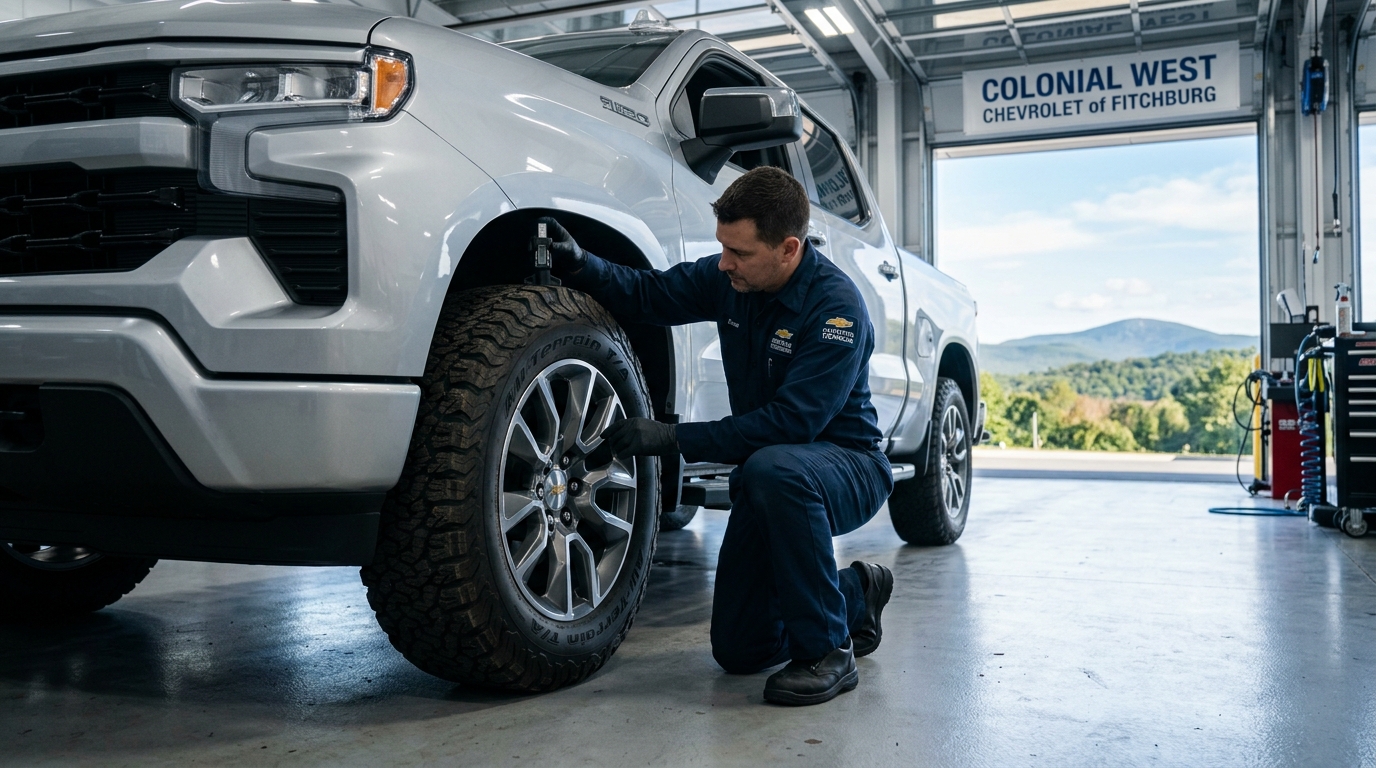
I have spent over a decade in service bays helping drivers understand that tires are the only part of your 2026 Chevrolet Silverado 1500 or 2026 Chevrolet Traverse that actually touches the pavement. When you are navigating the rolling hills around Gardner to head toward Mount Wachusett, that contact patch is what determines your stopping distance and steering response. At our service center, we do not just look at tread; we look at the specific engineering requirements of your vehicle to ensure the rubber matches the weight and torque of your 5.3L V8 engine.
Using a certified service center means your vehicle is handled by technicians who understand the specific load indices required for heavy-duty hauling. We see a lot of trucks coming in from the historic downtown district where drivers are carrying equipment for local manufacturing or landscaping. If you are using a tire with an incorrect load rating, you are not just wearing out the rubber faster; you are putting unnecessary stress on your suspension and braking systems.
We always recommend checking your tread depth and alignment at every oil change to maximize the life of your investment. If you have noticed your steering wheel pulling to one side or a vibrating sensation at highway speeds, it is time to have a professional look at your balance. You can easily book your next tire rotation online to keep your vehicle performing at its peak. We also keep our current tire and maintenance coupons updated so you can get the best value on name-brand rubber. For those who need help finding us, our Fitchburg service center is easy to locate, or you can give us a call at (978) 342-8713 to talk through your options.
Table of Contents
- Decoding Your Chevy Tire Sidewall and Tread Depth Requirements
- Standard Tire Sizes and Fitments for the 2026 Chevrolet Silverado 1500
- How Wheel Size and Aspect Ratios Impact Silverado Towing and Stability
- Determining the Largest Safe Tire Size for a Stock Silverado Suspension
- Maintaining Recommended Tire Pressures and Seasonal Care for New England Winters
Decoding Your Chevy Tire Sidewall and Tread Depth Requirements
A lot of folks look at the side of their tire and see a jumble of hieroglyphics, but those numbers tell the story of exactly what that tire can handle. For example, a common size like 265/65R18 starts with the width in millimeters, followed by the aspect ratio, which is the height of the sidewall as a percentage of the width. The R stands for radial construction, and the final number is the wheel diameter in inches. Understanding these codes is vital because fitting a tire with the wrong aspect ratio can throw off your speedometer and your Automatic transmission shift points.
Tread depth is the most critical safety metric we measure in the shop, and we follow the industry standard of recommending replacement at 2/32 of an inch. While some drivers think they can squeeze a few more miles out of a worn tire, wet-weather traction and hydroplaning resistance drop off significantly long before you hit that legal limit. We use specialized depth gauges to check the inner, center, and outer ribs of the tire because uneven wear is often a sign of an alignment issue or improper inflation.
When we see tires wearing heavily on the shoulders, it usually means they have been run under-inflated, which generates excessive heat and can lead to a blowout. Conversely, wear in the center of the tread suggests over-inflation. Keeping an eye on these patterns helps us catch suspension problems early, saving you money on more expensive repairs down the road. We want to make sure that when you hit the brakes, your Chevrolet has the grip it needs to stop exactly where you intended.
Standard Tire Sizes and Fitments for the 2026 Chevrolet Silverado 1500
The 2026 Chevrolet Silverado 1500 uses a variety of factory tire sizes depending on which trim you have in your driveway. A base Work Truck typically rolls out with 255/70R17 tires, which provide a lot of sidewall cushioning for job site durability. As you move up to the RST or LTZ trims, you will often see 265/65R18 or 275/60R20 fitments that balance a more aggressive look with highway comfort.
For those driving the High Country, the standard is often a 275/50R22 tire, which offers a very modern, low-profile appearance but requires more attention to road hazards due to the shorter sidewall. The ZR2 is the outlier here, coming from the factory with 33-inch Goodyear Wrangler Territory MT tires designed specifically for off-road performance. These tires feature a specialized tread compound that provides grip on rocks and mud while maintaining reasonable manners on the pavement.
We often help customers who want to switch from a highway-tread tire to an all-terrain option. While an all-terrain tire looks great and helps if you are frequently on gravel or dirt, it can slightly decrease your fuel economy. The TurboMax engine provides 430 lb-ft of torque, and having the right tire ensures that power actually makes it to the ground without spinning. We always cross-reference the door jamb sticker to ensure any new set of tires maintains the factory-specified load and speed ratings.
How Wheel Size and Aspect Ratios Impact Silverado Towing and Stability
Does a bigger wheel actually help you tow more? This is a question I hear a lot, and the answer is really about the relationship between the wheel and the tire sidewall. When you use an 18-inch wheel, you have more rubber between the rim and the road, which acts as a secondary cushion. This is often preferred by drivers who do a lot of heavy hauling on bumpy back roads because it absorbs more of the impact before it reaches the frame.
On the other hand, 20-inch wheels provide better lateral stability because there is less sidewall to flex when you are cornering with a trailer. This can make the truck feel more “planted” on the highway, especially when you are nearing the 13,300 lb max available trailering capacity of a properly equipped Silverado 1500. However, the trade-in for that stability is a slightly firmer ride, as the shorter sidewall cannot absorb road imperfections as effectively as a taller one.
We also have to consider the aspect ratio when talking about towing. A tire with a lower aspect ratio has a stiffer sidewall, which reduces that “squishy” feeling you might get when a heavy tongue weight is applied to the hitch. If you are using your truck for serious work, we often recommend a tire with an LT (Light Truck) designation rather than a P (Passenger) rating. LT tires have more internal plies, allowing them to handle higher pressures and heavier loads without overheating.
Determining the Largest Safe Tire Size for a Stock Silverado Suspension
I get asked all the time about how much rubber we can stuff under a truck without a lift kit. On a stock 2026 Chevrolet Silverado 1500 for Leominster, you can generally fit up to a 33-inch tire, such as a 275/60R20, without experiencing significant rubbing against the wheel wells or suspension components. This gives the truck a filled-out look and a bit more ground clearance without the need to modify the factory geometry.
If you try to go larger than a 33-inch tire on a stock setup, you will likely run into clearance issues when the steering wheel is at full lock. This can damage the plastic inner fender liners or, worse, catch on the metal of the wheel arch during suspension compression. We always check the offset of the wheels as well, because pushing the tires out too far can change the scrub radius and put extra strain on your wheel bearings and tie rods.
For drivers who want that extra beefy look, we often suggest staying within the factory-approved sizes used on the Trail Boss or ZR2 trims. These models come with a 2-inch factory-installed lift that allows for more vertical travel and better clearance for off-road tires. If you are sticking with a stock height, we recommend high-quality all-terrain tires that provide a deeper tread depth without increasing the overall diameter to a point where it compromises safety or performance.
Maintaining Recommended Tire Pressures and Seasonal Care for New England Winters
New England winters do not care about your schedule, so your tires have to be ready before the first frost hits. In rural areas like Ashburnham, where roads can stay icy and salt-covered for months, we strongly recommend dedicated winter tires with the three-peak mountain snowflake symbol. These tires use a specialized rubber compound that stays flexible in sub-freezing temperatures, whereas standard all-season tires can turn hard and lose their grip when it gets cold.
Proper inflation is your best defense against premature wear and poor fuel economy. For a 2026 Silverado 1500, the general recommendation is 35 PSI, but you should always check the sticker on your driver-side door jamb for the exact number. Remember that for every 10-degree drop in temperature, your tire pressure can drop by about 1 PSI. This means a sudden cold snap can trigger your tire pressure monitoring system, even if you do not have a leak.
Heavy road salt use in our area is another reason to stay on top of your tire and wheel care. Salt can cause corrosion on your valve stems and even lead to slow leaks where the tire bead meets the rim. We recommend regular undercarriage and wheel washes to keep that salt from eating away at your components. If you ever find yourself stuck with a flat in the snow, remember that your vehicle is covered by Chevrolet Roadside Assistance: 1-800-243-8872 for professional help when you need it most. If you need to stop by for a quick pressure check or a winter tire swap, our Fitchburg location is ready to help, or you can call us at (978) 342-8713 to set up an appointment.
© 2026 Colonial Chevrolet-West, INC.. All rights reserved.
Connect with us


