




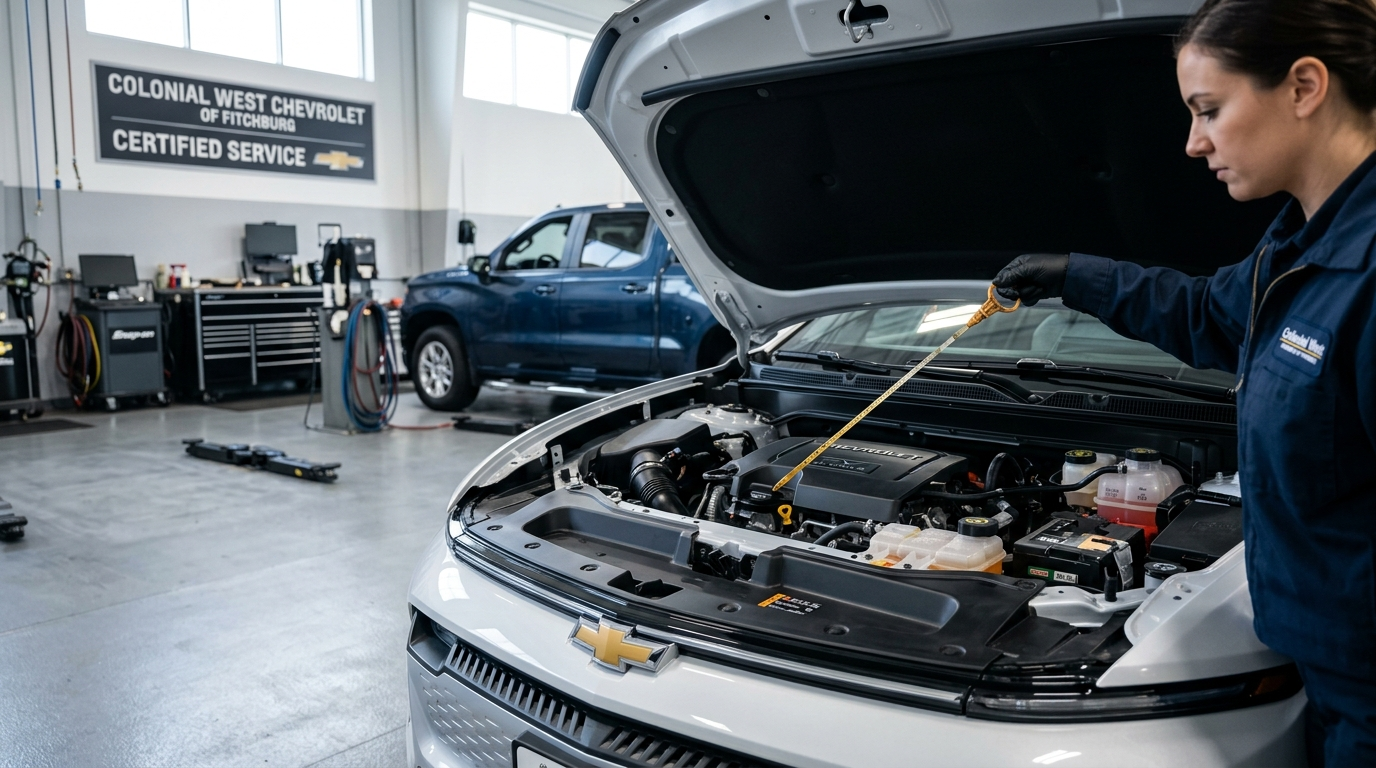
Maintaining the chemical integrity of your vehicle is the most effective way to ensure long-term reliability and performance. For the 2026 Chevrolet lineup, including versatile models like the 2026 Chevrolet Equinox, fluid management has become increasingly sophisticated. Most modern Chevrolet vehicles utilize an Engine Oil Life System, which monitors driving habits and engine temperatures to determine exactly when a change is needed. While this system can sometimes extend intervals to roughly 10,000 to 12,000 miles under perfect highway conditions, our team typically recommends a baseline of every 7,500 miles for engine oil and filter replacements to account for variable New England weather.
Beyond the engine, several other systems require scheduled attention to prevent mechanical fatigue. For instance, the 2026 Chevrolet Silverado 1500 and other trucks in the lineup generally require a brake fluid replacement at the 45,000-mile mark. Because brake fluid is hygroscopic—meaning it naturally absorbs moisture from the air—neglecting this service can lead to internal corrosion and a noticeable decrease in stopping power. Similarly, vehicles equipped with a limited-slip rear differential should have their rear axle fluid replaced at approximately 45,000 miles to protect the intricate gearing.
If you are noticing a “Change Engine Oil Soon” message or simply want to stay ahead of your maintenance schedule, you can easily book a maintenance appointment through our online portal. Our technicians perform a multi-point inspection with every visit, checking everything from washer fluid levels to transmission clarity. For those located near the historic furniture manufacturing district in Gardner, staying on top of these small top-ups prevents the need for major component flushes later in the vehicle’s life. If you have questions about a specific fluid color or smell, you can reach our service advisors at (978) 342-8713 for technical guidance. For a hands-on consultation, our Fitchburg service center is conveniently positioned to serve the entire north-central Massachusetts region.
Table of Contents
- The Impact of Severe-Duty Driving on Chevrolet Fluid Lifespans
- Maximizing Engine Protection with Dex-Cool Coolant Flushes
- Identifying Contaminated Brake Fluid and Restoring Stopping Power
- Dealership Expertise vs. National Transmission Chains for Chevrolet Fluid Services
- Managing DIY Maintenance and Chevrolet Warranty Protection
- Quick Answers Regarding Chevrolet Fluid Services
The Impact of Severe-Duty Driving on Chevrolet Fluid Lifespans
Operating a vehicle in a “severe-duty” environment significantly accelerates the rate at which lubricants and coolants break down. In our region, many drivers unknowingly fall into this category due to the specific demands of the local climate and terrain. Severe-duty driving includes frequent short trips where the engine never reaches full operating temperature, extensive idling, or towing heavy loads. For a 2026 Chevrolet Silverado 1500 used for hauling equipment or a 2026 Chevrolet Traverse frequently packed with seven passengers, the standard maintenance intervals are often too long to provide maximum protection.
The chemical additives in your fluids—such as detergents in motor oil or anti-foaming agents in transmission fluid—are consumed faster under high-heat or high-load conditions. In Gardner, where hilly terrain and sub-freezing winter temperatures are common, these fluids work harder to protect moving parts. For example, while a standard transmission fluid interval might be 90,000 miles, Chevrolet specifies a 45,000-mile interval for vehicles operated in severe conditions. This proactive approach ensures that the Automatic transmission continues to shift smoothly despite the added stress of mountain roads or stop-and-go traffic.
Environmental factors like road salt and dust also play a role in fluid health. Heavy winter road-salt use can lead to premature contamination of exposed components, while dusty backroads in more rural areas can clog the engine air filter well before the standard 22,500-mile replacement interval. We often see that a simple inspection at every 7,500-mile oil change can reveal if these filters or fluids are nearing the end of their effective lifespan. By adjusting your service cadence to match your actual driving environment, you preserve the mechanical integrity of the powertrain and avoid the higher costs associated with component failure.
Maximizing Engine Protection with Dex-Cool Coolant Flushes
Engine coolant is often the most overlooked fluid in a vehicle, yet it is responsible for managing the immense heat generated by modern turbocharged engines like the 1.5L I4 found in the 2026 Chevrolet Equinox. Most late-model Chevrolet vehicles utilize Dex-Cool, a long-life coolant designed to last significantly longer than traditional green formulas. Under normal operating conditions, the first coolant flush is typically recommended at 5 years or 150,000 miles. However, this interval is a maximum limit, not a suggestion to wait until the last possible moment.
Over several years, the pH balance of the coolant can shift, making it more acidic and less effective at preventing internal corrosion. This is particularly relevant for the aluminum components found in the 2.5L I4 engine of the 2026 Chevrolet Traverse. A professional coolant flush does more than just top off the reservoir; it removes scale, sediment, and degraded fluid from the radiator, heater core, and engine block. This process ensures that the battery thermal management systems (in electrified models) and engine cooling loops remain free of obstructions that could lead to overheating.
In Ashburnham, where winter temperatures frequently drop below zero, the “anti-freeze” property of your coolant is vital. If the mixture of water and coolant becomes unbalanced due to improper top-ups or leaks, the fluid can freeze, potentially cracking the engine block or radiator. During a routine multi-point inspection, our technicians use a refractometer to check the freezing point and boiling point of your coolant. This data-driven approach allows us to determine if a full flush is necessary to restore the protective properties required for another harsh New England winter.
Identifying Contaminated Brake Fluid and Restoring Stopping Power
How does a driver know when their brake fluid has reached its expiration date? Unlike engine oil, which turns dark as it traps carbon, brake fluid often degrades invisibly by absorbing moisture from the atmosphere. This moisture lowers the boiling point of the fluid, which can lead to “brake fade” during heavy braking scenarios—such as descending the steep grades near Mount Wachusett. If the fluid in the lines boils, it creates gas bubbles; since gas is compressible and liquid is not, the result is a soft or “spongy” brake pedal that requires more effort to stop the vehicle.
Visual cues can sometimes indicate a problem, even if the 2026 Chevrolet Silverado 1500 has not yet reached its 45,000-mile brake fluid service milestone. Fresh fluid is typically a light amber or clear color, while contaminated fluid appears dark, cloudy, or even green. If you notice a brake warning light on the dashboard or if your stopping distances seem longer than usual, these are urgent signals that the hydraulic system needs a professional flush. A full flush replaces all the old, moisture-laden fluid with fresh GM-spec brake fluid, ensuring that the anti-lock braking system (ABS) and stability control modules function exactly as intended.
Beyond performance, old brake fluid can be physically destructive to your vehicle. The moisture trapped in the fluid can cause internal rusting of the brake calipers, master cylinder, and expensive ABS valves. In the rural areas of Ashby, where emergency stops for wildlife are a reality, having a firm, responsive brake pedal is a critical safety requirement. By adhering to the recommended 45,000-mile replacement interval, you are not just maintaining a fluid; you are protecting the most important safety system on your vehicle.
Dealership Expertise vs. National Transmission Chains for Chevrolet Fluid Services
When it comes to specialized services like a transmission flush or a differential fluid change, the choice of where to take your vehicle matters. While national transmission chains offer general services, they often lack the model-specific tools and proprietary software required for modern Chevrolet vehicles. For example, many 2026 models feature sealed transmissions or systems that require a specific temperature-monitored fill process to ensure accuracy. Our factory-trained technicians use GM-spec fluids exclusively, such as the SAE 0W-20 full-synthetic engine oil required for the 2026 Chevrolet Equinox, ensuring total compatibility with your engine’s seals and sensors.
Choosing an authorized service center also ensures that your vehicle is checked for any outstanding “campaigns” or software updates that a general repair shop would miss. When we service a 2026 Chevrolet Silverado 1500, we aren’t just changing the oil; we are verifying the health of the 8 cameras with up to 14 views and ensuring the In-Vehicle Trailering App is functioning correctly. This holistic approach to maintenance is something national chains simply cannot replicate. Furthermore, using the correct fluids is essential for maintaining your powertrain 5 years / 60,000 miles warranty, as non-spec fluids can sometimes lead to denied claims if they cause component failure.
We also make professional maintenance more accessible by offering various service and parts discounts that rotate throughout the year. These specials often cover essential needs like oil changes, brake pads, and fluid flushes, providing dealership-level expertise at a competitive price point. By combining specialized knowledge with genuine parts and transparent pricing, we provide a level of care that helps your Chevrolet maintain its performance and resale value for years to come.
Managing DIY Maintenance and Chevrolet Warranty Protection
A common concern among owners is whether performing their own fluid top-ups or oil changes will impact their factory coverage. The short answer is that DIY maintenance does not void your basic 3 years / 36,000 miles or powertrain 5 years / 60,000 miles warranty, provided the work is done correctly and documented meticulously. If you choose to handle minor services yourself, it is vital to keep all receipts for the fluids and filters purchased, as well as a log of the date and mileage when the service was performed.
However, modern Chevrolet systems are increasingly complex, which can make DIY work challenging. Many 2026 models utilize sealed systems for power steering or specific transmission configurations that do not have a traditional dipstick. Overfilling or using the wrong fluid—such as a non-Dexos certified oil in the 2026 Chevrolet Equinox—can lead to engine damage that may not be covered under warranty. Because these vehicles rely heavily on sensors and electronic modules, even a simple fluid change may require a system reset that can only be performed with specialized diagnostic equipment.
For those who enjoy working on their own vehicles, we recommend limiting DIY tasks to simple items like windshield washer fluid or engine air filters. For more technical procedures, such as a Dex-Cool coolant flush or a high-pressure brake system bleed, the risk of air pockets or contamination is high. Entrusting these tasks to a certified technician ensures the work is performed to factory standards and is officially recorded in the GM service history, which can be a significant asset when it comes time to sell or trade in your vehicle.
Quick Answers Regarding Chevrolet Fluid Services
Q: What fluids need regular top-ups or flushes on a 2026 Chevrolet?
The primary fluids requiring attention are engine oil, engine coolant, brake fluid, and transmission fluid. While the Engine Oil Life System manages oil intervals, other fluids like the brake fluid in a 2026 Chevrolet Silverado 1500 should be replaced every 45,000 miles. Additionally, transfer case fluid and differential oil should be inspected regularly, especially on 4WD models.
Q: Does severe-duty driving change my fluid flush intervals?
Yes, severe-duty driving—which includes frequent towing, heavy idling, or driving in extreme temperatures—requires more frequent service. For example, if you frequently use your 2026 Chevrolet Traverse for towing, you should consider flushing the transmission fluid and inspecting the engine oil more often than the standard intervals suggest.
Q: How often does engine coolant need to be flushed on a 2026 Chevrolet?
Most 2026 models use Dex-Cool long-life coolant, which is typically rated for 5 years or 150,000 miles. However, we recommend a coolant test every winter, especially for drivers in Ashburnham, to ensure the mixture still provides adequate freeze protection and hasn’t become acidic.
Q: What symptoms indicate that my brake fluid is contaminated?
The most common signs are a soft or “spongy” brake pedal, increased stopping distances, or the fluid appearing dark and cloudy in the reservoir. If you experience any of these symptoms while driving through the hills of Gardner, you should have your brake system flushed immediately to restore hydraulic pressure.
Q: Will using a non-dealership service center void my Chevrolet warranty?
Using an independent shop or performing DIY maintenance will not void your warranty, but you must use GM-spec fluids and keep perfect records. For the best protection, visiting a certified center ensures that only genuine parts are used and that your service history is officially documented in the Chevrolet database. If you have questions about specific requirements, feel free to give our team a quick call or visit our Fitchburg location for a consultation.
© 2026 Colonial Chevrolet-West, INC.. All rights reserved.
Connect with us


